
Let's fix that. Here are the seven most common Section 179 mistakes we see, and exactly how to avoid them.
rEAD MORE
.png)
Section 179 is one of the most powerful tax deductions available to small business owners. It lets you write off the full cost of qualifying equipment in the year you buy it: instead of depreciating it over years. We're talking about computers, machinery, vehicles, furniture, and more. But here's the thing: most businesses leave money on the table. They make simple mistakes that cost them thousands: or they miss out on the deduction entirely.
Let's fix that. Here are the seven most common Section 179 mistakes we see, and exactly how to avoid them.
This is the big one.
A lot of business owners think that buying equipment before December 31 is enough. Not quite. The IRS requires that your equipment be purchased and placed in service by the end of the tax year.
What does "placed in service" mean? It means the equipment is delivered, installed, ready to use, and actively available for business operations. Just ordering it doesn't count. Having it sit in the box doesn't count either.
Don't wait until late December to order equipment. Plan your purchases in October or November to give yourself breathing room. If you order a piece of machinery on December 28 and it doesn't arrive until January, you've missed the deadline for that tax year: and your deduction.
Track delivery dates. Confirm installation schedules. Make sure everything is operational before year-end.
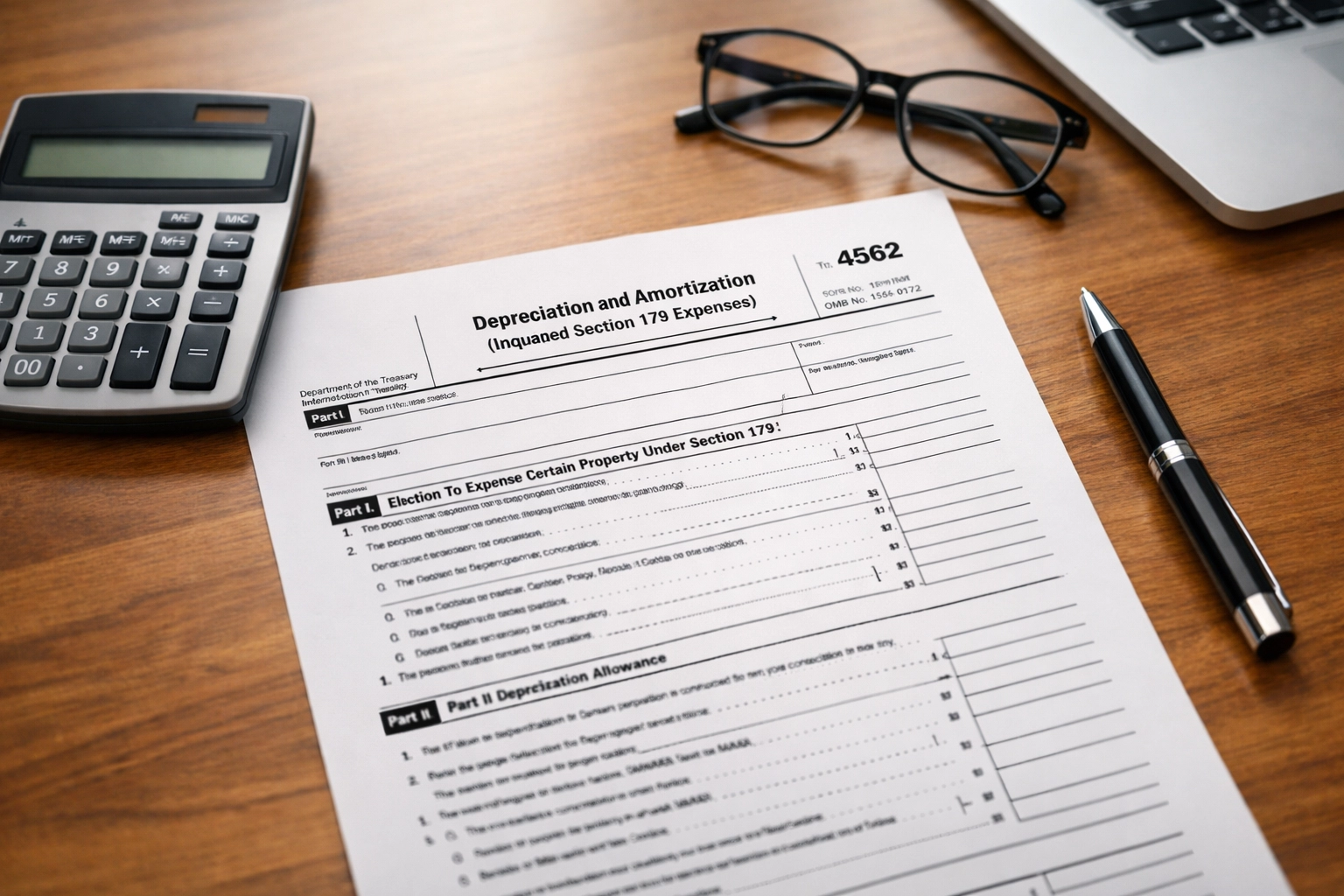
Here's a mistake that sounds minor but costs people big time: forgetting to actually elect the Section 179 deduction. You can buy qualifying equipment all day long. But if you don't explicitly claim the deduction on IRS Form 4562, you don't get it. And we've seen it happen: businesses spend $150,000 on equipment, then leave thousands of dollars on the table because they or their accountant forgot to check the right box.
Always file Form 4562 with your tax return if you're claiming Section 179. Make sure Part I of the form is completed and the deduction is properly elected. This isn't something you can fix retroactively without jumping through hoops, so get it right the first time.
If you work with a CPA or bookkeeper at Vincere Tax confirm they're aware of your equipment purchases and plan to claim Section 179. Don't assume it's automatic.
Not all assets are created equal in the eyes of the IRS. Equipment falls into different "recovery periods" based on what it is: some are 5-year property, some are 7-year, some are longer.
Misclassifying an asset means you could be depreciating it too slowly (and missing deductions in the early years) or too quickly (and triggering problems down the line).
For example: A restaurant owner buys an industrial oven. It's 5-year property. But if they classify it as 7-year property by mistake, they're leaving money on the table in years one through five.
How to Fix It:
Review IRS Publication 946 for guidance on asset classification. Keep a detailed fixed asset schedule. When in doubt, consult a tax professional who knows the rules inside and out.
And if you've already misclassified something? You can file an amended return or use Form 3115 to correct it. It's not the end of the world: but it's easier to get it right from the start.
The IRS doesn't just want to know you bought equipment. They want proof. And if you get audited and can't produce the right records, your deduction can be disallowed.
What do you need to document?
Missing or incomplete records create headaches during tax prep: and bigger headaches if you're ever audited.
How to Fix It:
Set up a system. Use a cloud-based folder (Google Drive, Dropbox, etc.) to store receipts, invoices, and delivery confirmations. Create a simple spreadsheet to track each asset with all the key details.
Make this a habit. Don't wait until tax season to scramble for paperwork. Document as you go.
Section 179 has limits. Two of them.
First: The deduction cannot create a loss. If your business has $100,000 in taxable income and you buy $150,000 in equipment, you can only deduct $100,000 this year. The remaining $50,000 can be carried forward to future years: but you can't use Section 179 to go negative.
Second: There's a phase-out threshold. For 2024, the maximum Section 179 deduction is $1,220,000. And if your total qualifying purchases exceed a certain amount (around $3 million), the deduction starts to phase out dollar-for-dollar.
These limits trip up a lot of businesses: especially those having a great year who go on a buying spree.
How to Fix It:
Know the current limits. They change every year, so check the IRS updates or work with your accountant to plan accordingly.
If you're bumping up against the income limit, understand how carryovers work. Unused Section 179 deductions can roll forward to future tax years when you have more income to absorb them.
And if you're spending big: over $1 million on equipment: run the numbers with a tax pro to maximize your deduction between Section 179 and bonus depreciation. Which brings us to the next mistake...

Here's something most people don't realize: not all states follow federal Section 179 rules.
Some states have lower limits. Some don't allow the deduction at all. If you assume your state return will mirror your federal return, you could be in for a surprise.
And then there's bonus depreciation: which works alongside Section 179. Bonus depreciation lets you deduct a percentage of an asset's cost after applying Section 179. The rules have changed over the years, but it's still a valuable tool that many businesses overlook.
How to Fix It:
Check your state's specific Section 179 rules before claiming the deduction. Your CPA should know this, but it's worth asking explicitly.
And when planning equipment purchases, consider both Section 179 and bonus depreciation together. Sometimes it makes sense to maximize Section 179. Other times, splitting the deduction between Section 179 and bonus depreciation saves you more money. Run the numbers.
A lot of businesses think about Section 179 only in December. But that's backward.
Section 179 works best when it's part of your long-term tax planning strategy: not a last-minute scramble to reduce your tax bill.
Rushed decisions lead to missed deadlines, delayed installations, or purchases that don't actually align with your business needs. You end up buying equipment just for the tax break, not because it makes operational sense.
How to Fix It:
Plan equipment purchases strategically throughout the year. Meet with your tax advisor in Q3 or Q4 to review your projected income and discuss whether Section 179 makes sense for you.
Ask yourself: Do I actually need this equipment? Will it improve my business? Or am I just chasing a deduction?
The best tax strategy is one that supports your business goals: not one that dictates them.
Section 179 is a powerful tool. But like any tool, it only works if you use it correctly.
Avoid these seven mistakes, and you'll keep more of your money where it belongs: in your business, not in Uncle Sam's pocket.
Need help navigating Section 179 or planning your year-end tax strategy? We specialize in helping small business owners maximize deductions and minimize headaches. Reach out to our team and let's make sure you're not leaving money on the table.
.png)
At Vincere Tax, we've got the skills and know-how to craft a unique, tailored plan just for you. Trust us – we've got the expertise to make it happen!
Speak with an expert Website Terms.png)
.png)
.png)
Copyright © 2025 Vincere Tax| All Rights Reserved
Privacy Policy
.png)


.png)
